Legal resources

Practical Information and Digital Resources

Readable legal updates, practical guidance, employer guides, and editable resources designed to improve legal awareness, preparation, and documentation.

General information—not individualized legal advice.

The materials on this website are provided for general informational purposes only. They are not a substitute for legal advice based on the specific facts and documents of a particular matter. Laws, regulations, administrative requirements, and judicial interpretations may change.

8 items

Legal articles

Faithful article-style adaptations of public posts by Formilleza Law Offices.

Illegal Dismissal May Carry SSS Liability Beyond Backwages

A Supreme Court ruling highlights that an illegal dismissal can create statutory consequences beyond backwages and separation pay.

In Lopez Sugar Corporation v. Perrin, Jr., et al., employees who had already been awarded backwages and separation pay in lieu of reinstatement later sought the SSS contributions corresponding to the period of their illegal dismissal.

The Supreme Court held that illegally dismissed employees are deemed never to have left their employment. The employer's obligation to remit their SSS contributions therefore did not cease during the period covered by the backwages.

The Court also clarified that:

  • Claims involving unpaid SSS contributions fall within the jurisdiction of the Social Security Commission.
  • A prior illegal-dismissal judgment does not necessarily bar a later claim for unremitted SSS contributions.
  • A general satisfaction of judgment or quitclaim does not automatically waive the employer's statutory obligation to remit SSS contributions.

Case reference: Lopez Sugar Corporation v. Romeo Perrin, Jr., et al., G.R. No. 260447, February 5, 2026, Supreme Court, Third Division

For general legal information only. This article is not a substitute for advice on a particular case.

View original Facebook post

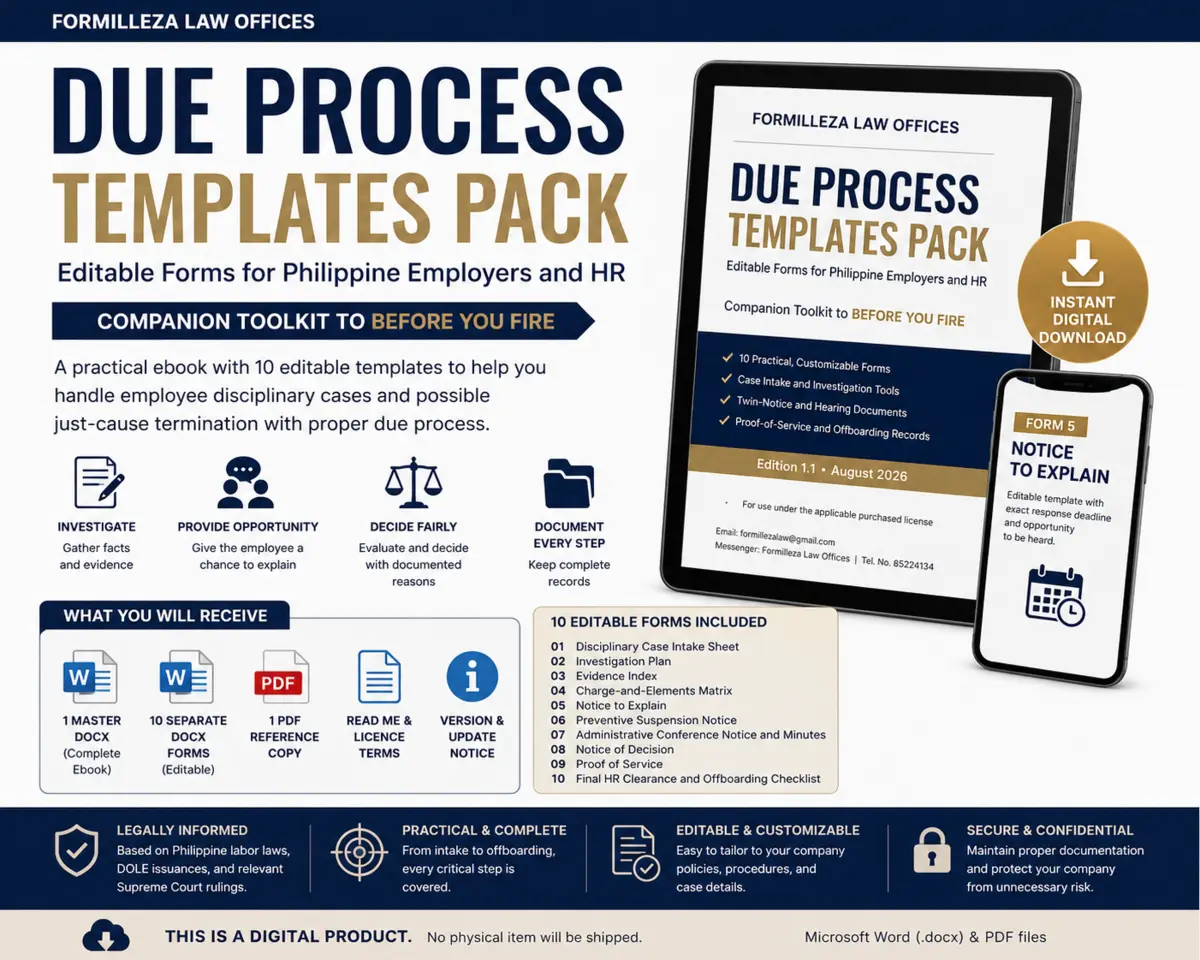
Handling an Employee Disciplinary Case? Start With the Right Documents

A Notice to Explain is only one part of a properly documented employee disciplinary process.

A more organized disciplinary file follows the case from the initial report and investigation plan through the employer's final decision and offboarding steps. The documents should be adapted to the facts of the case and the company's applicable rules.

A practical disciplinary file may include:

  • Disciplinary case intake form
  • Investigation plan
  • Evidence index
  • Charge and elements matrix
  • Notice to Explain
  • Preventive suspension notice, when applicable
  • Administrative conference notice and minutes
  • Decision notice
  • Proof of service
  • Final HR clearance and offboarding checklist

For general legal information only. This article is not a substitute for advice on a particular case.

View original Facebook post

The Biggest Mistake Employers Make When Preparing a Termination Notice

A termination notice is the employer's final written justification for dismissal, not merely a letter announcing that employment has ended.

If a dismissal is challenged before the NLRC or the courts, the termination notice may become one of the most important documents in the case. It should objectively explain what was established and why the employer concluded that dismissal was warranted.

A well-prepared notice should:

  • State the lawful ground for dismissal.
  • Summarize the facts established during the investigation.
  • Explain why the employee's explanations were found insufficient, when applicable.
  • Connect the proven facts to the legal ground or company rule relied upon.
  • Confirm that due process was observed.
  • State the effective date of termination and any post-employment instructions.

Common mistakes include:

  • Repeating allegations from the Notice to Explain without discussing what was actually proven.
  • Giving conclusions without explaining their factual basis.
  • Omitting the employee's defenses.
  • Using emotional or accusatory language instead of objective findings.
  • Citing the wrong legal ground or company rule.

For general legal information only. This article is not a substitute for advice on a particular case.

View original Facebook post

Guides and templates

Digital resources for employers and HR